
Home › Coverages 12 Coverages Explained › Drain, Sewer & Septic Contractor Insurance
Insurance for drain, sewer and septic contractors
Drain cleaning insurance, sewer contractor insurance and septic contractor insurance start with the same general liability, auto and workers' comp as any plumbing shop. The difference is underground: XCU endorsements, pollution and mold exclusions, and the exclusions for the pipe you're working on decide how well that package holds up on a sewer claim.
- Since 2003
- 12+ A-rated carriers
- 28 states
- Independent agents
Start your plumber insurance quote
Takes about a minute. A licensed agent follows up.
Licensed in 28 states · NPN 7642818 · Since 2003
Why drain cleaning and sewer contractor insurance is different
Drain and sewer work happens where a standard plumbing policy is weakest: below grade, inside old pipe and around raw sewage. A shop that only clears sinks and swaps toilets can live with a basic package. A shop that jets mains, digs laterals, bursts pipe or pumps septic tanks needs its policies read line by line.
The risks stack up fast:
- Buried utilities. Gas, water, electric and fiber lines run close to every lateral you dig or bore.
- Brittle pipe. Clay, Orangeburg and old cast iron can crack or collapse under a jetter nozzle or a burst head.
- Sewage inside occupied buildings. A backup during a cleaning call puts waste on floors, walls and belongings.
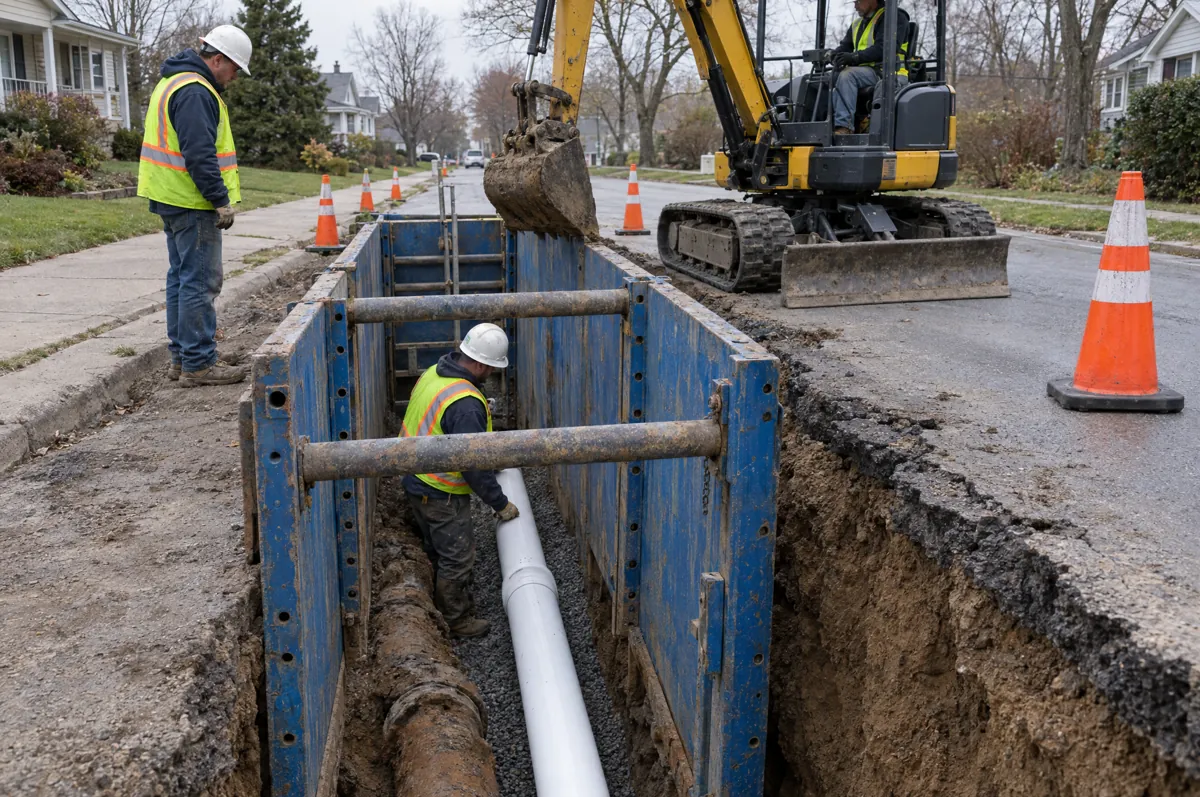
- Trench and confined-space injuries. Digging crews face cave-ins, and drivers haul heavy trailers and tanks.
- Trucks carrying waste. A septic pumper hauls the very thing many policies exclude.
- City streets. Reaching a main often means cutting into the public right-of-way, which brings permits and bonds.
Your core coverage stack
Must-have
General liability
Third-party injury and property damage from your work, including problems that surface after the job. Check it for XCU and fungi endorsements. General liability for plumbers
Pollution liability
Sewage, mold and bacteria claims that your GL may exclude. For drain and sewer shops this is a core policy, not an extra. Pollution liability
Workers' comp
Injuries to your techs and diggers, rated by class code. Workers' comp for plumbers
Commercial auto
Service vans, jetter trailers, dump trucks and pumper trucks, plus the pollution endorsement a pumper needs. Commercial auto
Tools and equipment
Jetters, sewer cameras, locators and bursting rigs, on the truck or on the job. Tools and equipment
Often needed
Commercial umbrella
Higher limits for municipal, commercial and GC work. Umbrella insurance
License and permit bonds
Street-opening, drain layer and septic license bonds. License and permit bonds
Sewer coverage caveats
Here are eight places where a generic plumber's policy can fall short on sewer and septic work. Every one depends on your exact policy wording, so treat this as a list of questions to ask, not a ruling on your coverage.
Trenchless and pipe bursting
Bursting and directional boring move a lot of ground without a trench, and the risk is what's nearby: a neighbor's gas service, a shallow water line, a foundation footing. Those exposures connect to the XCU underground and collapse hazards and to the "that particular part" exclusions above. Whether a given XCU endorsement reaches a bursting job depends on its wording, since ISO's version is written around grading, excavating, tunneling, drilling, pile driving, demolition and shoring. Describe your trenchless work plainly on the application so there's no argument later.
Your faulty work vs. the damage it causes
General liability usually won't pay to redo your own bad work, like a lateral you relined wrong. It may pay for the damage that work causes to other property. The standard "your work" exclusion has an exception for work your subcontractors did, but many carriers remove it by endorsement (ISO CG 22 94 is one). States also differ on whether faulty work counts as an "occurrence" in the first place.
Trench work and workers' comp class codes
Most drain cleaning stays in plumbing's own workers' comp class. In states using the NCCI system, that's class 5183, and its scope includes cleaning building sewer connections with portable equipment. Sewer construction is a separate class, 6306, which covers storm and sanitary sewer projects of any pipe size or depth. Some states, like California, New York, New Jersey and Pennsylvania, use their own codes.
The rates can differ a lot. For example, Indiana's advisory rates for January 1, 2026 are $0.924 per $100 of payroll for 5183 and $1.540 for 6306. If your crews do both kinds of work and your payroll records don't show the split, an auditor may put more of it in the higher class. Our guide to workers' comp audits for plumbers explains how to document it.
Septic licensing and bonds
Septic installers and pumpers often need a separate state or local license on top of a plumbing license. Three examples from our states:
- Minnesota. An MPCA license is required to design, install, maintain, pump or inspect septic systems, and it requires general liability plus a surety bond of at least $25,000.
- Ohio. Installers, septage haulers and service providers register with the local board of health and must show a surety bond or other financial assurance.
- Florida. Septic tank contractors must be registered. The program moved to the Department of Environmental Protection on July 1, 2021, and county health departments still handle permits and inspections.
Rules vary by state and county, so check with your state health or environmental agency.
What cities, GCs and property owners will ask you for
Sewer work brings more paperwork than most plumbing. Expect requests like these:
- Street-opening and right-of-way permits. Cutting into a street or sidewalk to reach a main usually needs a city permit, and many cities want a permit bond and proof of insurance first. In New York City, DOT issues street opening permits to contractors including licensed master plumbers, who register with GL and workers' comp certificates and post a permit bond where the rules call for one. Nashville requires excavation contractors to post a $40,000 permit bond and carry at least $1 million of GL with Metro named as additional insured.
- Separate sewer licenses. Chicago, for example, requires a drain layer contractor license with a $50,000 bond for sewer work.
- GC and municipal contracts. Additional insured status, a waiver of subrogation and, on some jobs, proof of pollution coverage. Our certificate of insurance guide walks through each one.
Requirements and bond amounts differ by city, so call the public works or DOT office before you bid. Our state pages cover the statewide rules. Get a quote for your plumbing business →
Growing a drain and sewer business
Most drain shops grow in steps, and each step changes the insurance:
- Cable machines and a camera. GL, commercial auto and a tools floater for the camera and locator.
- A jetter trailer. More equipment value to schedule, and more chances to damage fragile pipe. This is when the "that particular part" exclusions start to matter.
- An excavation crew. XCU, trench injuries and the sewer construction class code come into play, along with street-opening bonds.
- Trenchless equipment. Bursting and boring rigs to insure, and utility-strike exposure to talk through with your carrier.
- A pumper truck. The auto pollution endorsement, septic licensing and bonding.
- Municipal and commercial contracts. Higher limits through an umbrella and, on larger public jobs, performance and payment bonds.
Tell us where you are on that list and where you're headed. We'll put the work in front of the carriers most likely to write it. Get a quote for your plumbing business →
Drain, sewer and septic insurance questions
Does general liability cover a sewer line that breaks while I'm jetting it?
Do drain cleaners need pollution insurance?
What workers' comp class code is drain cleaning?
Do septic pumper trucks need an MCS-90?
Do I need a bond to dig in the street for a sewer repair?
Related coverage and guides
Ready to see what you'd pay?
Independent agents, 12+ A-rated carriers, and a licensed agent back to you within one business day.