
Home › Coverages 12 Coverages Explained › Installation Floater Insurance for Plumbers
Installation floater insurance for plumbers
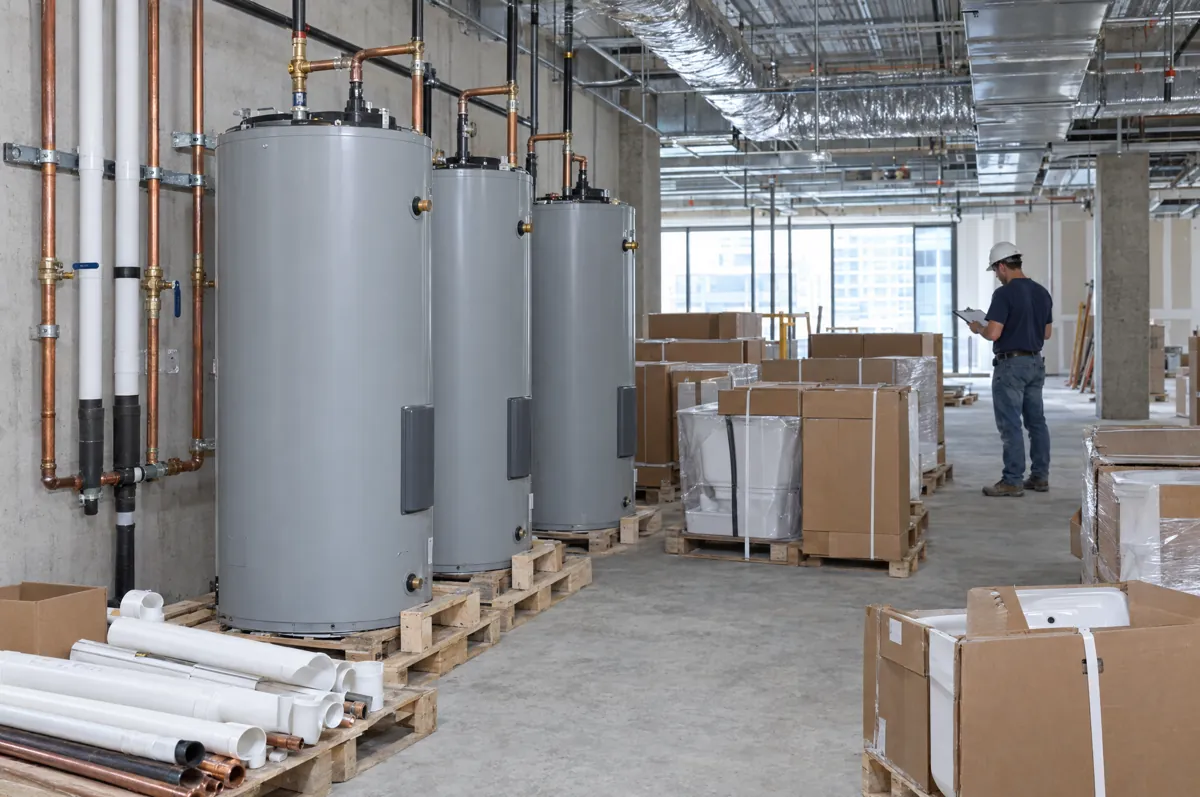
Installation floater insurance covers the water heaters, fixtures, pipe and boilers you're installing while they're in transit, stored or on site, until the work is finished or accepted. Plumbers on new construction often need one because the GC's builder's risk policy may not reach their materials before they're installed.
- Since 2003
- 12+ A-rated carriers
- 28 states
- Independent agents
Start your plumber insurance quote
Takes about a minute. A licensed agent follows up.
Licensed in 28 states · NPN 7642818 · Since 2003
What installation floater insurance covers for a plumber
Installation floater insurance is inland marine coverage for property you're installing. It protects the materials and equipment headed into a job, such as water heaters, fixtures, pipe, pumps and boilers. Coverage applies while they're on your truck, stored at the site or another location, and installed but not yet handed over. It usually ends when your installation is complete, the work is accepted, or the owner's interest takes over.
Here's why it matters. On many jobs, you buy the material, and it's your loss until the owner accepts it. A pallet of tankless units stolen from a half-built house or a boiler damaged before startup can wipe out the profit on the whole job.
It's easy to mix this up with two other policies:
- Builder's risk covers the whole structure under construction. The owner or GC usually buys it, often with a limit equal to the project's completed value.
- A contractors equipment floater covers your tools and machines. An installation floater covers what you're putting into the building, not what you use to put it there.
Where general liability takes over
The floater protects the material itself. Your general liability covers something different: injury or damage your work causes to other people's property. Once a job is finished, the "completed operations" part of a standard GL policy, which covers damage that shows up after you've left, is what usually responds if a water heater you set later leaks into a finished basement. One policy covers your stuff before the handoff. The other covers the damage your work can do after it.
| What it covers | What it usually doesn't |
|---|---|
| Water heaters, fixtures and pipe on your truck on the way to the job | Your tools and machines (that's a tools and equipment floater) |
| Materials stored at the site or a staging location | The building as a whole (that's builder's risk, usually the owner's or GC's) |
| Installed work the owner hasn't accepted yet | Material after the job is accepted or put to its intended use |
| Boilers, pumps and water treatment equipment you're setting | Injuries or damage your work causes to others (that's general liability) |
| Theft or damage to staged material, depending on the form | Anything the policy form or schedule leaves out |
Where installation floater claims come from
These are made-up examples to show the gap the floater fills. Real coverage depends on your policy and the project's builder's risk.
The ground-floor storage unit
Example scenario: A plumbing sub stages 40 tankless water heaters in a locked ground-floor unit of a new apartment building, ready for trim-out. Over a weekend, someone cuts the lock and takes 12 of them. The GC's builder's risk policy carves out contractor materials that haven't been installed yet. The sub's installation floater is the policy that may pay to replace the units.
The boiler before startup
Example scenario: A commercial plumbing crew sets a new boiler in a school's mechanical room. Two days before startup, another trade's lift backs into it and crushes the burner housing. The work hasn't been accepted, so the boiler is still the plumber's problem. An installation floater may pay to repair or replace it while the parties sort out who was at fault.
Setting your limit and what drives the price
Size your limit to the most material you'll ever have at risk on one job at one time, staged or installed and not yet accepted. For a service plumber, that might be one water heater on the truck. For a commercial sub on a mid-rise, it can be a whole floor's worth of fixtures and a mechanical room full of equipment.
When you shop the policy, ask:
- Is there a separate, lower limit for material in transit or in storage away from the site?
- Does the policy cover all your jobs for the year, or one project at a time?
- What's the deductible, and does it apply per job or per loss?
- Does coverage end at installation, at acceptance, or at whichever comes first?
There's no reliable public median for installation floater premiums. Your price depends on payroll, revenue, claims history, the work you do and the limits you choose, and a carrier will want to know the kind of projects you take and the value of material you typically have on site. Get a quote for your plumbing business →
Which plumbers need an installation floater
Plumbers on new construction often need one most, because that's where material sits on site for weeks before anyone accepts it. That includes:
- Commercial and multifamily subs who stage fixtures and equipment floor by floor. See commercial plumbing contractor insurance.
- Shops that set boilers, water heaters and booster pumps on tenant build-outs.
- Residential plumbers doing new homes or large remodels, where you buy the tubs, valves and water heaters up front. See residential plumber insurance.
Material prices make the case on their own. A commercial water heater, a booster pump package or a few pallets of copper can tie up more cash than a small shop clears in a month, and you're carrying that risk until someone signs off on the work.
It's a growth coverage. The jobs that bring big material buys are often the same ones that ask for performance and payment bonds and higher liability limits. Once you're a client, we can send certificates on your existing coverage the same day a GC asks.
Installation floater requirements by state
States don't usually require an installation floater. The push comes from your subcontract, which may leave you responsible for your own materials until the work is accepted. Read its risk-of-loss and insurance sections before you sign.
Where your state matters is how much new building is going on. In fast-growing markets, more of your work sits on unfinished job sites. Three examples from our state research:
- Texas. About 32% of Austin's housing and 29% of Fort Worth's was built in 2010 or later. See Texas plumber insurance.
- Colorado. A quarter of Denver's housing dates from 2010 or later. See Colorado plumber insurance.
- Alabama. In Huntsville, 27% of housing was built in 2010 or later, and 10% since 2020. See Alabama plumber insurance.
See all of our licensed states. Get a quote for your plumbing business →
Coverage that pairs with an installation floater
Installation floater questions from plumbers
What's the difference between an installation floater and builder's risk?
Who pays for builder's risk, the GC or the subcontractor?
Does an installation floater cover my tools?
When does installation floater coverage end?
Do residential plumbers need an installation floater?
Ready to see what you'd pay?
Independent agents, 12+ A-rated carriers, and a licensed agent back to you within one business day.